




How often do you feel pulled in a hundred directions at once – at work, online, or simply trying to keep up with life?
This April, as we observe Stress Awareness Month, it might be worth noticing how stress actually shows up for us – not just in big moments, but in the quieter, everyday ones.
In reality, each of us has a different stress threshold: a point where pressure shifts from something manageable into something overwhelming. A certain level of stress can help us stay alert, focused and motivated. But when it builds beyond what we can comfortably hold, it begins to affect how we think, feel and function.
And stress rarely arrives all at once.
It tends to build gradually – through constant notifications, growing to-do lists, and the subtle pressure to always stay “on”. A deadline here, a quick scroll there, another responsibility to carry. Each one feels manageable on its own, but together, they can start to take a toll.
None of these feel dramatic. But they’re not random either.
Stress is, in many ways, a signal – a quiet indication that something in our lives may need attention.
You might think of it like ripples in the water.

At first, they’re small and barely noticeable. But when left unattended, they begin to spread. What starts as mild fatigue can slowly turn into exhaustion. Small worries can grow into constant overthinking. Even our interactions with others can begin to shift – we might become more irritable, impatient or withdrawn without realizing it.
From Signal to Response
There isn’t a single way to manage stress. But there are small ways we might begin to meet it differently.
Pause and Breathe
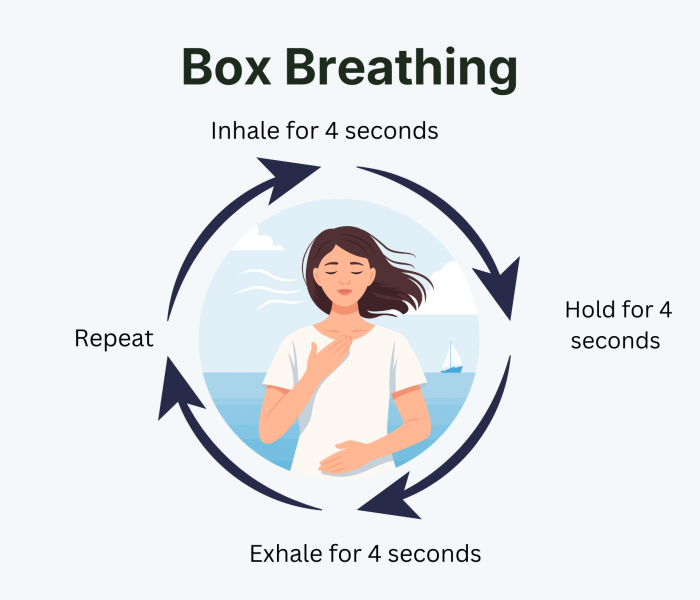
At times, it starts with something as simple as noticing the body. In moments of pressure, breathing often becomes shallow without us realising. The body speeds up, even when we haven’t paused to catch up with it. Gently slowing the breath even for a minute or two can create just enough space to feel a little more steady again.
A simple tool that can be applied is known as the ‘Box Breathing’ technique as shown below:
Identify Your Circle of Control
From there, things can feel a little clearer.
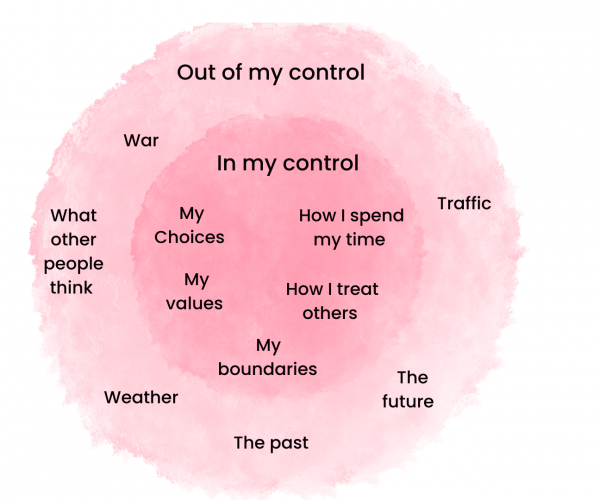
What felt overwhelming a moment ago sometimes begins to separate into what can be acted on and what cannot. And that distinction matters. When everything feels urgent, it’s easy to carry more than we need to.
For example, you can control how you respond to a tight deadline, whether you ask for help, or how you manage your time and energy. But you cannot control unexpected changes at work, other people’s actions or sudden disruptions in plans.
When we begin to focus only on what is within reach, the weight often feels more manageable. It gives us a place to start and a sense that not everything is out of our hands.
Have a Safe Outlet to Express
Still, not everything needs to be processed alone.
There are moments when simply talking things through with someone we trust can shift the experience. Not because the situation has changed, but because we’re no longer holding it all by ourselves.
And sometimes, words aren’t even necessary. Writing, drawing or creating something with our hands can offer a different kind of release – one that doesn’t require everything to be fully understood. Even simple creative activities have been shown to reduce stress in the body.
It might be as simple as:
- journaling or free-writing,
- sketching, doodling, or colouring,
- simple crafts, like clay, knitting, or origami,
- music or gentle movement, like humming, stretching, or slow dancing
The focus isn’t perfection – it’s giving yourself the space to express, process and simply be.
Set Gentle Boundaries to Protect Your Energy
Along the way, we may also start to notice where our energy is going.
It’s easy to say “yes” out of habit or to keep going without checking in on our limits. But small pauses before taking on something new or in deciding when to step away can quietly protect that energy.
Not in a rigid way, but in a way that allows us to remain present for what matters.
Setting gentle boundaries might look like:
- saying “no” when your plate is full
- being clear about your capacity
- carving out small pockets of time to recharge
Even small actions like turning off notifications after hours or pausing before saying “yes” can make a difference. Think of boundaries as a buffer. They reduce overwhelm and create space for what truly matters.

Prioritise Restorative Rest
And then, there’s rest.
Not just the kind where we stop working, but the kind that actually restores. The kind where the mind slows down, even briefly. Where there’s space to breathe, to be or to do something that feels grounding without needing to be productive.
Restorative rest means allowing your mind and body to fully pause and reset. It’s giving yourself permission to slow down, step away from demands and engage in activities that genuinely replenish you.
This could look like:
a quiet walk in nature,
a calming hobby,
mindfulness,
or simply doing nothing for a while.
Over time, this kind of rest doesn’t just reduce fatigue – it supports everything else, helping us respond more steadily to whatever comes our way.
Stress doesn’t disappear completely. And perhaps it’s not meant to.
This Stress Awareness Month, it is a gentle space and invitation to:
notice the signals a little earlier and to respond with a bit more intention.
Not all at once.
Not perfectly.
Just one small shift at a time.
References:
- Bomester, O. (2025). The Role of Personal Boundaries in Psychological Well-Being: A Theoretical Review . Asian Journal of Research in Education and Social Sciences. 7(7), 535-554. https://doi.org/10.55057/ajress.2025.7.7.44
- Cochran, J. (2025, December 29). Managing Anxiety with the Circle of Control – Alaska Behavioral Health. Alaska Behavioral Health. https://alaskabehavioralhealth.org/managing-anxiety-with-the-circle-of-control/
- Jang, E., Hyo Bhin Choi, & Kim, M. (2024). The Restorative Effects of Urban Parks on Stress Control Ability and Community Attachment. Sustainability, 16(5), 2113–2113. https://doi.org/10.3390/su16052113
- Kaimal, G., Ray, K., & Muniz, J. (2016). Reduction of cortisol levels and participants’ responses following art making. Art Therapy, 33(2), 74–80. https://doi.org/10.1080/07421656.2016.1166832
- Marks, H., & King, L. M. (2024, June 19). Stress Symptoms. WebMD. https://www.webmd.com/balance/stress-management/stress-symptoms-effects_of-stress-on-the-body
- Mayo Clinic. (2023, November 18). Stress management Stress basics. Mayo Clinic. https://www.mayoclinic.org/healthy-lifestyle/stress-management/basics/stress-basics/hlv-20049495
- Wellington, V. U. of. (2023, March 20). To vent or not to vent: is letting out our feelings actually helpful? | News | Victoria University of Wellington. Www.wgtn.ac.nz. https://www.wgtn.ac.nz/news/2023/03/to-vent-or-not-to-vent-is-letting-our-feelings-out-actually-helpful