







Asthma management involves more than treating symptoms; it requires proper medications, correct inhaler use, and healthy lifestyle habits. With the right treatment and lifestyle strategies, people with asthma can prevent attacks, stay active, and enjoy a better quality of life.
Asthma Treatments: The Two Types of Inhalers
Asthma management usually involves two types of inhaler and each plays a different role in keeping symptoms under control and preventing attacks.
1. Relievers (Quick-Acting Medication)
Short-acting beta agonists (SABA) inhalers, such as Salbutamol, are quick-acting reliever medications used by people with asthma. They are vital because they provide fast relief of breathlessness, chest tightness, or wheezing, making them essential for emergencies or sudden flare-ups (1). However, SABA should be used only when absolutely necessary, because studies show that relying on SABA (defined as using three and more canisters per year) is linked to poor asthma control and a higher risk of severe exacerbations (attacks) (1). This overuse is dangerous because SABA only relaxes the airway muscles quickly—it does not treat the underlying inflammation—which can mask worsening disease.
2. Controllers (Long-Term Medication)
Inhaled corticosteroids (ICS) are the main controller treatment recommended for people with asthma as the foundation of long-term asthma management (1). They are essential because they work by reducing the underlying airway swelling (inflammation). When used daily at a the required dose, ICS is highly effective at reducing symptoms, lowering the risk of asthma attacks, hospitalisation, and death (1). This medication must be taken consistently every day. Adherence is crucial, as poor adherence often leads patients to rely too much on their reliever inhaler (SABA), which significantly increases the risk of severe and potentially fatal exacerbations.
How to Use Inhaler Correctly
Correct inhaler technique ensures the medicine actually reaches the lungs. The Malaysian Clinical Practice Guideline(CPG) (2) recommends reviewing techniques at every clinic visit and giving every patient a written action plan. Using your inhaler correctly is extremely important for making sure your medicine works. Inhalers are designed to deliver the medicine straight into your lungs, which is the fastest and most effective way to treat breathing problems, thus learning how to use it properly is proven to reduce your symptoms and prevent serious flare-ups (3). That’s why learning the correct steps helps you avoid unnecessary trips to the hospital. Here are 4 common mistakes of using inhalers as per Malaysian CPG 2024.
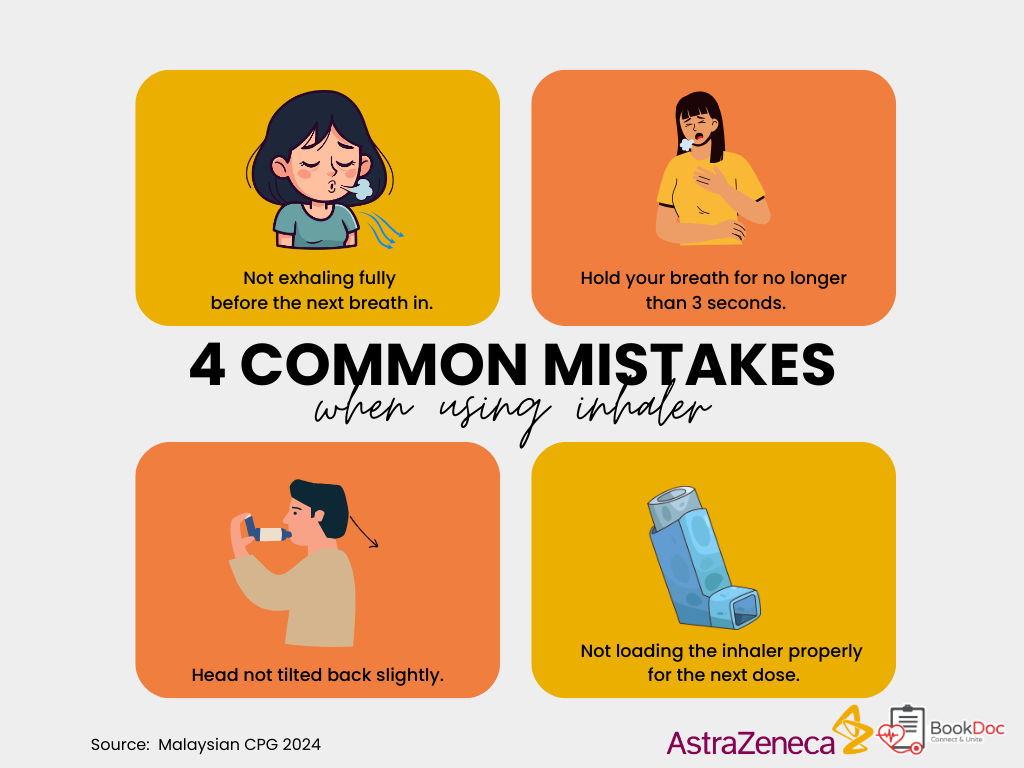
While the exact process varies slightly depending on whether you use a Metered-Dose Inhaler (MDI, which looks like an L-shaped can), a Dry Powder Inhaler (DPI, which often looks like a disk or cylinder), or a Soft Mist Inhaler (SMI, which is slightly larger, cylindrical, and produces a slow-moving mist), these are the general principles you must follow (4).
| Step | Action |
| 1.Prepare the inhaler |
|
| 2 Breathe Out |
|
| 3.Position the inhaler correctly |
|
| 4.Inhale the medicine properly |
|
| 5.Hold Breath |
|
| 6.Breathe out slowly |
|
| 7.Rinse Mouth |
|
Beyond Medication: Lifestyle Strategies for Better Asthma Control and Quality of Life
Taking control of your asthma involves more than just using your inhaler; making a few key lifestyle changes is proven to significantly improve your quality of life by making symptoms less frequent and severe.
- Smoking and vape cessation – Must do
Smoking cessation is one of the most critical steps in asthma management and this directive applies to any patient with asthma who is an active smoker or vaper, as well as those exposed to second-hand smoke (1). This action is necessary because active smoking drastically worsens asthma outcomes by causing more airway swelling, reducing the effectiveness of inhaled medicines, and accelerating lung function decline. Conversely, quitting is proven to reduce the frequency of flare-ups, slow lung decline, and significantly improve overall quality of life. Therefore, clinicians must counsel and encourage cessation at every clinic visit (1). This is achieved by offering and providing support like counseling and formal stop-smoking programs, which are known to increase long-term success rates (1).
- Environmental triggers – What to avoid
The strategy of avoiding specific environmental triggers applies to individuals with allergic asthma, for whom identifying and avoiding these triggers is the key recommended action (1). This proactive approach is necessary because controlling the home environment is a cornerstone of non-medication management, and trigger avoidance reduces inflammation,
improves lung function, and significantly improves health-related quality of life by minimizing symptomatic days (1). This avoidance is relevant both inside and outside the home. Inside, it involves targeted interventions such as removing pets, house dust mites or fixing damp areas and mold. Outside, it includes strategies like staying indoors when air pollution is high (e.g., smog), which directly reduces exposure to irritants (1).
- Physical Activity – yes, you can exercise!
Regular physical activity is strongly encouraged for people with asthma, as the notion that they must avoid exercise is inaccurate, provided their asthma is well-controlled. This inclusion is vital because exercise helps the heart and lungs work more efficiently, improving overall fitness. High-quality reviews confirm that aerobic exercise programs are safe and result in clinically significant improvements in exercise capacity, lung function, and reduced asthma symptoms (1), directly leading to an improved quality of life by increasing physical capability. Regular activity should be part of a healthy asthma management plan. Patients can participate safely even with exercise-induced bronchoconstriction (EIB) by ensuring they use pre-exercise medication and that their baseline asthma is controlled (1).
- Follow-Up and Adherence: Keys to Better Control
Regular follow-up with healthcare professionals and adherence to prescribed asthma therapy are essential strategies to improve disease control and quality of life. These measures are important because they allow clinicians to assess inhaler technique, reinforce adherence, monitor symptoms and lung function, and adjust treatment to prevent attack, reduce night awakenings, and enhance daily functioning (1). All asthma patients, particularly those with poor control or at risk of improper inhaler use, should engage in these practices at every clinic visit and before stepping up or modifying therapy. This can be achieved by regular assessment of inhaler technique, encouragement of consistent medication use, and guideline-based treatment adjustments, which together lead to better symptom control and ultimately enhancing overall quality of life (5).
- Breathing Exercises as Complementary Therapy
Breathing exercises are valuable complementary approaches for people with asthma to use alongside their conventional drug therapy, specifically Buteyko and Papworth methods are highly beneficial because they help patients breathe more efficiently, reduce shortness of breath, and promote relaxation, leading to a consistently improved health-related quality of life (1). Studies show that breathing exercises and yoga, when added to usual care, are better at improving quality of life over the long term (up to 12 months). However, it is crucial to understand that these methods do not reduce the risk of severe asthma attacks (exacerbations) or permanently improve lung function (for breathing exercises alone) but it does help in improving quality of life. (2).
- Dietary and Nutrition Support for Asthma Management
Dietary choices play a supportive role in lung health and inflammation management for people with asthma. The most important action is to focus on consuming a diet rich in fruits and vegetables, as there is consistent evidence linking this type of diet to better lung protection (1). This is beneficial because the antioxidants and anti-inflammatory compounds found in produce are associated with improved asthma control, a reduced risk of flare-ups, and support overall well-being, which contributes positively to managing the chronic condition and improving quality of life (1). This healthy diet should be maintained consistently at every meal and the best way to do it is by applying the “quarter-quarter-half” guideline recommended by the Ministry of Health where half of the plate is filled with vegetables and fruits (6). Other approaches, such as using fish oil or Vitamin D supplements, have mixed or unproven results for the general asthma
population, so the primary focus should remain on a whole food diet (1). These are examples of quarter-quarter-half plate that can help you visualize better how does it looks like in real life.

Conclusion: Prevent Attacks, Live Better
Asthma management is driven by two critical factors: mastering your medication and optimizing your lifestyle. Consistent use of Inhaled Corticosteroids (ICS) as the controller and reliever to relieve asthma symptoms, delivered with the right inhaler technique. It is important for stable control and preventing asthma attacks. These medical steps must be supported by proactive measures, including quitting smoking and embracing regular physical activity. By integrating these actions, individuals can stop merely reacting to symptoms and start living a healthy, significantly improved quality of life.
Click this link to find out more: https://mysihatpal.com.my/breathe-better/asthma-management#main-section
Written by Dietitian Jamilah
Reference
- Global Initiative for Asthma (GINA). (2025). Global Strategy for Asthma Management and Prevention (2025 Update). https://ginasthma.org/wp-content/uploads/2025/11/GINA-2025-Update-25_11_08-WMS.p df
- Malaysian Health Technology Assessment Section (MaHTAS). (2024). Clinical Practice Guideline: Management of Asthma in Adults (Second Edition). Ministry of Health Malaysia.
https://www.moh.gov.my/moh/resources/Penerbitan/CPG/Respiratory/e-CPG_Managem ent_of_Asthma_in_Adults_%28Second_Edition%29_-_11_4_25.pdf
- Marko, M., Klimczak, M., Sobczak, M., Wojakiewicz, M., Dębowski, T., Emeryk, A., & Pawliczak, R. (2025). Effective inhaler technique education is achievable—assessment and comparison of five inhaler devices errors. Frontiers in Pharmacology, 16, Artikel 1538283. https://doi.org/10.3389/fphar.2025.1538283
- Cataldo, D., Hanon, S., Peché, R. V., Schuermans, D. J., Degryse, J. M., De Wulf, I. A., De Backer, W. A., & Degroote, E. (2022). How to choose the right inhaler using a patient-centric approach? Advances in Therapy, 39(3), 1149–1163. https://doi.org/10.1007/s12325-021-02034-9
- Mohd Isa, N. A., Cheng, C. L., Nasir, N. H., Naidu, V., Gopal, V. R., & Alexander, A. K. (2020). Asthma control and asthma treatment adherence in primary care: results from the prospective, multicentre, non-interventional, observational cohort ASCOPE study in Malaysia. The Medical journal of Malaysia, 75(4), 331–337.
- Tan, L. K., Chua, E. H., Mohd Ghazali, S., Cheah, Y. K., Jayaraj, V. J., & Kee, C. C. (2023). Does Awareness of Malaysian Healthy Plate Associate with Adequate Fruit and Vegetable Intake among Malaysian Adults with Non-Communicable Diseases? Nutrients, 15(24), 5043. https://doi.org/10.3390/nu15245043
Approval code: MY-18935_Jan2026