







When Your Brain Speaks, Are You Listening?
Forgetting where you placed your keys. Struggling to focus by mid-afternoon. That foggy, sluggish feeling that makes even simple tasks harder than they should be.
Many of us write these off as “just tiredness” — something a strong coffee will fix. But what’s on your plate may be playing a bigger role than you think.
This World Brain Day (22 July), themed “Brain Health: Access for All,” we’re diving into a simple but powerful idea: food for thoughts — literally. What you eat doesn’t just fuel your body. It shapes how well your brain works, day after day.
The Connection Between Food and Brain Health
Your brain uses a significant share of your daily energy just to keep you thinking, moving, and feeling — and it relies heavily on the nutrients you take in to do that well.
Research shows this connection is closer than most people realise:
- Diets high in ultra-processed foods have been linked to a higher risk of depressive symptoms, even after accounting for other lifestyle factors.
- Even mild dehydration has been shown to measurably impair attention, executive function, and reaction time.
- Diets rich in fruits, vegetables, and fish have been associated with a lower risk of cognitive decline over time.
In short: your daily food choices are quietly shaping your focus, memory, and mood — which ties directly into this year’s theme of making brain health achievable for everyone, everywhere.
What Does Your Brain Actually Need?
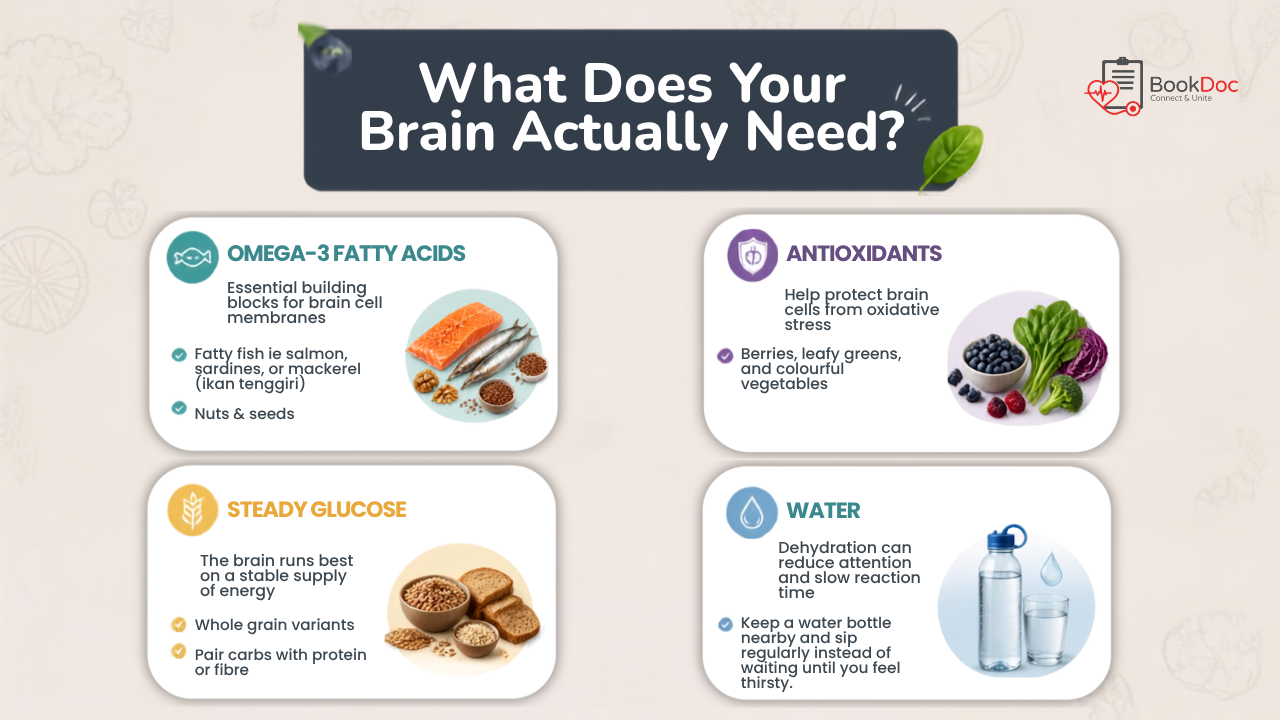
Beyond calories, your brain relies on specific nutrients to function properly.
- Omega-3 fatty acids are essential building blocks for brain cell membranes. Research links higher omega-3 levels to better memory, processing speed, and attention.
How to apply: Get more of it by adding fatty fish like salmon, sardines, or even local options such as mackerel (ikan tenggiri) to your meals a couple of times a week, or snacking on a handful of nuts such as walnuts and flaxseeds.
- Antioxidants help protect brain cells from oxidative stress — a gradual process of cellular damage linked to cognitive decline as we age.
How to apply: Adding berries, leafy greens, and colourful vegetables into your meals is an easy way to work more of these into your day.
- A steady glucose supply is what your brain runs on. Unlike the sharp spike-and-crash from refined sugar, a stable supply keeps energy and concentration consistent.
How to apply: Swap white bread and white rice for wholegrain versions, and pair carbs with protein or fibre to slow the release.
- Water makes up roughly 75% of your brain’s composition. Even mild dehydration has been shown to reduce sustained attention and slow reaction time.
How to apply: Keep a water bottle within reach and sip regularly, rather than waiting until you feel thirsty.
💡 Tip: These nutrients work best together — a diet that’s rich in one but poor in others won’t give your brain everything it needs.
In fact, researchers often describe good nutrition as one of the simplest, most accessible tools for lifelong brain health — which ties directly into this year’s theme of making brain health achievable for everyone, everywhere.
Beyond Food: Other Brain Health Habits
Nutrition is a powerful lever, but it works best alongside a few other daily habits:
- Move your body – Regular physical activity increases blood flow to the brain and supports long-term cognitive health. A brisk 20–30 minute walk a few times a week can make a real difference.
- Protect your sleep – Your brain consolidates memory and clears out toxins during sleep. Set a consistent bedtime and limit screens before bed.
- Manage stress – Chronic stress affects brain function over time. Simple habits like deep breathing or short breaks during the day can help.
If you experience sudden or severe memory loss, frequent confusion, persistent headaches, or noticeable changes in speech or coordination, these aren’t things diet alone can fix — speak to a healthcare professional early.
Conclusion – Small Habits, Sharper Mind
Your brain works quietly behind everything you do — but when it’s under-fuelled, you feel it.
This World Brain Day, take a moment to check in with what you’re feeding your mind. Small, food-first habits — more omega-3s, more antioxidants, steadier blood sugar, better hydration — can go a long way in supporting sharper focus and long-term brain health.
Because brain health, like gut health, isn’t about perfection — it’s about consistency. And in line with this year’s theme, that consistency should be something everyone, everywhere, has the chance to build.
Written by Jonathan, BookDoc Dietitian
References:
- Yang, X., et al. (2025). A systematic review and dose response meta-analysis of Omega-3 supplementation on cognitive function. Scientific Reports. https://www.nature.com/articles/s41598-025-16129-8
- Solfrizzi, V., Panza, F., et al. Nutritional contributions to dementia prevention: main issues on antioxidant micronutrients. Genes & Nutrition. https://pmc.ncbi.nlm.nih.gov/articles/PMC3968291/
- Ozojide, K. O., Chukwu, V. U., Adeyemo, D. A., Akinade, O., Okobi, O. E., Lucien, J. G., & Aliu, V. (2025). Ultra-Processed Food Intake, Obesity, and Mood Disorders: An Epidemiological Study From the National Health and Nutrition Examination Survey (NHANES) 2005 to 2018 Data. Cureus, 17(7), e87975. https://www.ncbi.nlm.nih.gov/pmc/articles/PMC12351661/
- Wittbrodt, M. T., & Millard-Stafford, M. (2018). Dehydration Impairs Cognitive Performance: A Meta-analysis. Medicine & Science in Sports & Exercise. https://pubmed.ncbi.nlm.nih.gov/29933347/